Written by: Russ Hudson (Cannabis Chemistry Collection)
Edited by: Jacqueline Graddon, MBA (CFO, Cannabis Consultants Group)
Reviewed by: Christianson, Jesse, DNP, APNP, AGPCNP-BC (Founder & Formulator, Dr. Murse LLC | CannabisDNP); Schwabe, Anna, Ph.D. (CSO, True Cut Genomics); Hoyo, Mariana, M.D. (Medicina Integrativa & Endocannabinoide)
Introduction
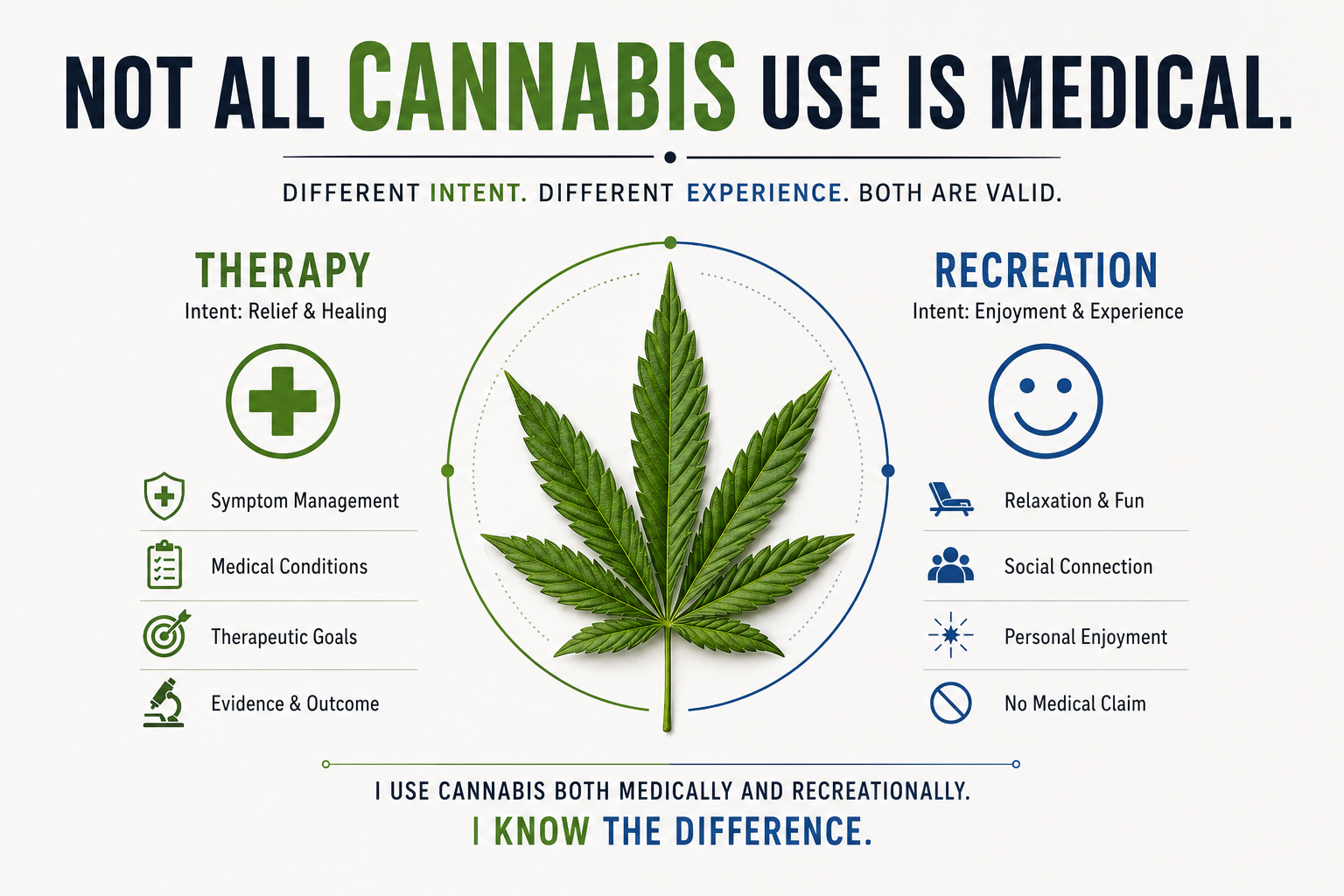
The often-repeated claim that all cannabis use is medical is incorrect, libelous in spirit, and insulting to free-thinking cannabis users everywhere. However, this claim has gained rhetorical appeal in an industry shaped by prohibition, stigma, fragmented regulation, and decades of bad-faith moral panic. The “all use is medical” claim is also scientifically imprecise; cannabis use can be medicinal or therapeutic, but it can also be recreation, ritual, intoxication, pleasure, experimentation, boredom relief, social lubrication, sensory exploration, or simple adult enjoyment. There is nothing wrong with using cannabis solely for the fun or enjoyment of it.
The position that cannabis lacks medical value is also false. Rather, the stronger position is that the word “medical” should retain discriminating power. If every cannabis use case that changes mood, reduces stress, produces pleasure, aids sleep, or alters bodily experience is reclassified as medical, the term stops functioning as a scientific, clinical, or policy category. The aim of this article is therefore definitional, evidentiary, and ethical: this piece is both to defend medical cannabis where the evidence supports it, and to defend recreational cannabis without apology. The cannabis industry must reject the increasingly common habit of laundering ordinary pleasure through medical language.
Defining Medical Use
Medical use is not defined merely by pharmacological activity; it is defined by a relationship between a substance, an intended use, intended outcome, a health-related target, and an evidentiary or clinical framework. Regulatory definitions make this clear. For example, the European Medicines Agency defines a medicinal product as a substance or combination of substances intended to treat, prevent, or diagnose disease, or to restore, correct, or modify physiological functions through pharmacological, immunological, or metabolic action (European Medicines Agency [EMA], n.d.). In U.S. regulatory language, products move into medical territory when they are intended for use in diagnosis, cure, mitigation, treatment, or prevention of disease, or intended to affect the structure or function of the body within the relevant statutory framework (Federal Food, Drug, and Cosmetic Act, 21 U.S.C. § 321(g)(1) (2026)).
The key word here is “intended.” Caffeine, for instance, affects physiology, but a morning coffee is not usually considered medical care. Wine affects anxiety, pain perception, sleep architecture, appetite, and social behavior, but ordinary wine consumption is not automatically medicine. Exercise changes inflammatory signaling, glycemic control, endocannabinoid tone, mood, pain tolerance, and sleep, but a Saturday hike is not necessarily a prescribed medical intervention. The same simple logic detailed here also applies to cannabis; a pharmacological effect can support medical use, but pharmacological activity alone does not establish that every use is medical.
This distinction matters because medical language carries claims about purpose, evidence, safety, dosage, suitability, monitoring, and risk-benefit evaluation. Without those boundaries, “medical” becomes a prestige label rather than an analytic category.
Defining Recreational Use
Recreational cannabis use is not a lesser, dismissive, or morally inferior category. We can define it as cannabis use primarily motivated by enjoyment, intoxication, social experience, curiosity, sensory enhancement, celebration, boredom relief, or other non-clinical purposes. These motives are not hypothetical. Motive research consistently identifies cannabis use as multi-determined, with common motives including coping, enhancement or enjoyment, expansion, social use, and conformity (Gex et al., 2024). This research is bolstered by a study differentiating medicinal and recreational cannabis users which found that sleep, social anxiety, and coping motives were associated with greater odds of medicinal use, while enjoyment, boredom, simultaneous alcohol use, and celebration were associated with greater odds of recreational use (Vedelago et al., 2020). That distinction is exactly what the “all use is medical” slogan erases. The literature does not show a single motive disguised under many names; instead, it shows multiple motives that map imperfectly, but meaningfully, onto medical and non-medical use.
Recreational use can be rational, lawful in some jurisdictions, culturally meaningful, and personally beneficial without being medical. Adults do not need a pathology to justify pleasure, and the fact that this sentence still needs writing says plenty about drug policy and lingering cultural and generational shame.
The Same Person Can Have Different Intentions
The most scientifically defensible framework is not a rigid binary, but a contextual model. For example, a person may use cannabis medically on Monday for neuropathic pain, recreationally on Friday to enjoy music, and ambiguously on Sunday to relax, sleep, or decompress. The user does not become one fixed type; instead, the use case carries the relevant intention, context, product choice, dose, expected outcome, and risk-benefit logic.
Population data support this overlap. In a nationally representative survey of U.S. adults, Schauer et al. (2016) found that among current cannabis users, only 10.5% reported using cannabis exclusively for medicinal purposes, compared with 53.4% who used exclusively for recreational purposes and 36.1% who reported both medicinal and recreational use. Therefore, 89.5% of current cannabis users reported at least some recreational use (Schauer et al., 2016). Furthermore, a systematic review of self-reported medical cannabis use suggests that the boundary between medical and non-medical use is often porous rather than clean (Leung et al., 2022).
This overlap should not be surprising; human behavior is rarely arranged for the convenience of survey instruments. While this means that mixed motives are normal, they do not prove that all motives are medical. Rather, they prove that a simplistic binary can fail at the individual level while still preserving a meaningful distinction at the level of use, intention, and evidence.
Pharmacology ≠ Medicine
Medicine is not simply “something that changes the body.” If that were the criterion, every intoxicant, stimulant, sedative, food, workout, sauna, orgasm, horror movie, and argument on LinkedIn would qualify. The issue is not whether cannabis affects physiology, as it clearly does; the issue is whether the use is directed toward a defined health target under a plausible therapeutic rationale and, ideally, an evidence-informed dosing and safety framework.
A substantial review and analysis by the National Academies of Sciences, Engineering, and Medicine (NASEM) is useful here precisely because it does not flatten all use into one category (NASEM, 2017). It identifies areas of conclusive or substantial evidence, areas of moderate evidence, areas of limited evidence, and areas where evidence is insufficient or absent. This graded approach is the opposite of the concept that “all use is medical.” Evidence-based medicine requires discrimination among claims, and the cannabis industry would do well to adopt this novel approach.
Therapeutic Benefit vs. Medical Intent
A recreational act may incidentally produce therapeutic benefits. For example, a person may consume cannabis to enjoy a film and also experience reduced pain. Another may use cannabis socially and sleep better afterward. These effects can be real, but incidental benefit does not automatically define the use as medical.
This important distinction is familiar in other domains:
- A person may go for a run because it feels good, but it also incidentally lowers their blood pressure. The run has health benefits, but it was not necessarily medical treatment.
- A person may read fiction to relax and incidentally reduce stress. That does not make the novel a psychiatric intervention.
- A person may drink beer and temporarily reduce anxiety. That does not make beer anxiolytic medicine.
These same principles apply to cannabis: therapeutic effect, therapeutic intent, and medical evidence are related but not identical.
This is also important for patient protection, because if “I feel better” is treated as sufficient evidence of medical use, then subjective relief becomes immune to critique, even when better evidence shows limited efficacy, poor durability, adverse effects, dependence risk, or worsening outcomes in some populations. The 2026 Lancet Psychiatry systematic review and meta-analysis of cannabinoids for mental disorders and substance-use disorders found little evidence supporting routine cannabinoid treatment for many psychiatric conditions, no significant effects for anxiety, PTSD, psychotic disorders, anorexia nervosa, or opioid use disorder, and no randomized-trial evidence for depression treatment (Wilson et al., 2026). The study did find low-to-moderate certainty evidence supporting cannabinoids specifically for insomnia, autism traits, and cannabis use disorder. But the lack of evidence for the former conditions does not mean no individual ever feels relief; it means relief claims require more than rhetorical enthusiasm and a receipt from a local dispensary.
The Logical Consequences of “Everything Is Medical”
Again, the claim that all cannabis use is medical often rests on the expansive theory that if someone uses cannabis to relax, sleep, escape stress, feel pleasure, reduce anxiety, improve appetite, or tolerate life under late capitalism, then the use is medical. The problem isn’t that these effects are impossible, it’s that the logic is not cannabis-specific. If relaxation makes cannabis medical, then vacations are also medical. If mood elevation makes cannabis medical, then music, comedy, sex, dancing, gaming, fiction, and dessert are also medical. If escape from reality is medical, then alcohol, streaming television, fantasy novels, and three-hour YouTube rabbit holes about ancient masonry or dogs on skateboards are medical. If improved sleep after pleasurable use is medical, then nearly anything that induces fatigue or calm becomes a sleep intervention. The category of “medical” use collapses in an indefensible heap.
Scientific categories should help distinguish phenomena, not dissolve them – that is the point. A definition that includes nearly everything excludes almost nothing. That is not compassion or even tolerance; it’s mostly semantic inflation as it turns “medical” into a decorative sticker applied to any behavior the speaker wants to dignify, justify…or legalize.
Why the Industry Promotes This Narrative
The “all cannabis use is medical” claim did not appear in a vacuum. It emerged from a history in which medical necessity was often the safest public argument for reform. Patients with cancer, AIDS, epilepsy, multiple sclerosis, chronic pain, and other serious conditions helped shift public perception because their suffering exposed the cruelty of prohibition, and that history deserves respect.
Nevertheless, a strategy developed under prohibition can become intellectually absurd under legalization. The medicalization of all cannabis use can serve several industry functions: reducing stigma, creating moral cover for intoxication, softening opposition from policymakers, elevating products above ordinary consumer goods, and implying therapeutic legitimacy where product-specific evidence may not exist. None of those incentives requires a conspiracy because markets naturally reach for whatever language sells, and “medicine” certainly sells better than “I wanted to be pleasantly altered while eating cereal and watching adult cartoons.”
Ultimately, this creates a credibility problem; when companies, advocates, or influencers imply that every pre-roll, edible, concentrate, beverage, terpene blend, or high-THC product is part of a medical practice, they blur the line between evidence-based therapeutic use and commercial storytelling. Medical cannabis deserves better than being used as a tongue-in-cheek justification for every product category in the store.
The Cost of Abandoning Scientific Precision
Imprecision has consequences, and we see this often in the cannabis industry. For clinicians, broad medical claims complicate discussions of dosing, contraindications, drug interactions, psychiatric risk, route of administration, product variability, and follow-up. For regulators, the collapse of medical and adult-use categories makes it harder to design appropriate labeling, advertising, access, tax, and quality-control rules. For researchers, vague claims make it harder to define exposure, indication, endpoint, product type, cannabinoid dose, terpene and other phytochemical content, and expected outcome. For patients, inflated claims can encourage substitution of cannabis for treatments with stronger evidence.
Correcting this post-modern bro-science does not require hostility toward cannabis. Serious cannabis science requires and depends on specificity. NASEM’s conclusions support certain therapeutic applications while noting that for many conditions there is insufficient or no evidence to assess therapeutic effects (NASEM, 2017). Wilson et al. (2026) similarly emphasized the scarcity and low certainty of evidence for many mental-health indications. The scientific response to uncertainty is not slogan-making; the proper response is better trials, better product characterization, better adverse-event tracking, and narrower claims precisely because overclaiming harms advocacy.
Let us be clear that opponents of cannabis do not need help finding weak arguments, so when advocates insist that all use is medical, they create an easy target. A more durable position is simpler: some cannabis use is medical, some is recreational, some is mixed, and all those categories can be legitimate under appropriate law and public-health policy. It’s all okay, folks. Read that again.
A Better Framework
A more defensible framework recognizes three categories: medical use, recreational use, and overlapping use. This model protects the legitimacy of patients without pathologizing pleasure.
- Medical use: cannabis or cannabinoid use primarily intended to prevent, treat, mitigate, or manage a health condition or symptom, ideally with evidence-informed product selection, dosing, risk assessment, and monitoring.
- Recreational use: cannabis use primarily intended for enjoyment, intoxication, social experience, sensory enhancement, curiosity, celebration, boredom relief, or other non-clinical purposes.
- Overlapping use: cannabis use in which medical and recreational motives coexist, either within the same episode or across different episodes in the same person.
This framework is compatible with the motive literature, which identifies both coping-related and enhancement-related reasons for use (Gex et al., 2024). It is compatible with survey evidence showing mixed medical and recreational use among a substantial portion of current users (Schauer et al., 2016). It is compatible with therapeutic evidence showing real but condition-specific benefits (NASEM, 2017; Abrams, 2018). And it is compatible with adult-use policy, which need not pretend that intoxication is always healthcare to justify legal access.
The framework also respects language; medical use should mean something, recreational use should not be treated as an accusation, and mixed use should be acknowledged without being forced into either box. This is not an anti-cannabis approach; it is an anti-nonsense approach.
Conclusion
The claim that all cannabis use is medical is simply not necessary to defend cannabis, patients, legalization, or getting high. Cannabis can be medically valuable without every use being medicine, and recreational cannabis can be legitimate without borrowing medical language for moral cover.
The better argument is more precise and much more honest: cannabis is a pharmacologically complex plant and product category with evidence-supported medical applications, unresolved therapeutic questions, measurable risks, and widespread non-medical uses. People use cannabis for pain, nausea, spasticity, sleep, anxiety, appetite, pleasure, music, sex, laughter, or just relief from the unbearable administrative absurdity of being alive. Some of those uses are medical, and some are not. Some are mixed.
These distinctions should be preserved not because recreational use is shameful, but because it is not. In summary;
- Adults should not need to invent a diagnosis to justify pleasure.
- Patients should not have their serious medical use diluted by marketing slogans.
- Researchers and clinicians should not be asked to pretend that all motives are one motive.
- And policymakers should not build laws around semantic smoke.
Not all cannabis use is medical, and that’s okay.
References
Abrams, D. I. (2018). The therapeutic effects of cannabis and cannabinoids: An update from the National Academies of Sciences, Engineering and Medicine report. European Journal of Internal Medicine, 49, 7–11. https://doi.org/10.1016/j.ejim.2018.01.003.
European Medicines Agency. (n.d.). Medicinal product. www.ema.europa.eu/en/glossary-terms/medicinal-product.
Federal Food, Drug, and Cosmetic Act, 21 U.S.C. § 321(g)(1) (2026).
Gex, K. S., Gückel, T., Wilson, J., & Lee, C. M. (2024). Why people use cannabis and why it matters: A narrative review. Current Addiction Reports, 11, 1045–1054. https://doi.org/10.1007/s40429-024-00599-3.
Leung, J., Chan, G., Stjepanović, D., & Hall, W. (2022). Prevalence and self-reported reasons of cannabis use for medical purposes in USA and Canada. Psychopharmacology, 239(5), 1509–1519. https://doi.org/10.1007/s00213-021-06047-3.
National Academies of Sciences, Engineering, and Medicine. (2017). The health effects of cannabis and cannabinoids: The current state of evidence and recommendations for research. National Academies Press. https://doi.org/10.17226/24625.
Schauer, G. L., King, B. A., Bunnell, R. E., Promoff, G., & McAfee, T. A. (2016). Toking, vaping, and eating for health or fun: Marijuana use patterns in adults, U.S., 2014. American Journal of Preventive Medicine, 50(1), 1–8. https://pubmed.ncbi.nlm.nih.gov/26277652/.
Vedelago, L., Metrik, J., & Amlung, M. (2020). Differentiating medicinal and recreational cannabis users via cannabis use motives. Cannabis, 3(1), 52–63. https://doi.org/10.26828/cannabis.2020.01.006.
Wilson, J., Dobson, O., Langcake, A., Mishra, P., Bryant, Z., Leung, J., Dawson, D., Graham, M., Teesson, M., Freeman, T. P., Hall, W., Chan, G. C. K., & Stockings, E. (2026). The efficacy and safety of cannabinoids for the treatment of mental disorders and substance use disorders: A systematic review and meta-analysis. The Lancet Psychiatry, 13(4), 304–315. https://doi.org/10.1016/S2215-0366(26)00015-5.
Leave a Reply
You must be logged in to post a comment.