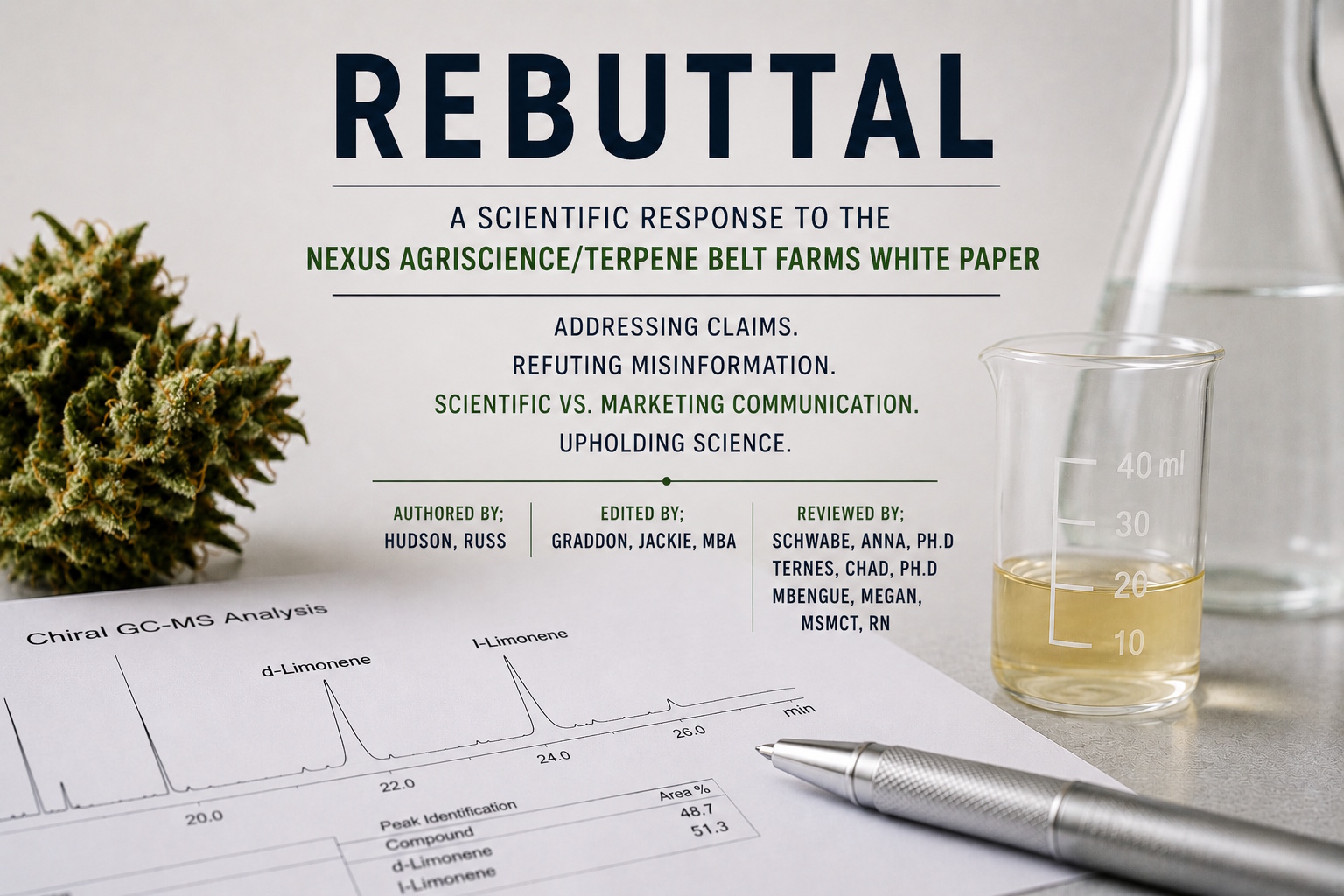
Author: Hudson, Russ (The Cannabis Chemistry Collection)
Editor: Graddon, Jackie, MBA (Cannabis Consultants Group)
Reviewers: Schwabe, Anna, Ph.D. (CSO, True Cut Genomics); Ternes, Chad, Ph.D. (CEO Phlo Bio); Mbengue, Megan, MSMCT, RN (Entheacare).
One-Paragraph Summary
The Nexus/Terpene Belt Farms white paper correctly identifies stereochemistry as an important and often overlooked aspect of terpene chemistry, but repeatedly extends limited analytical observations beyond what the data support. The paper demonstrates that selected hemp cultivars possessed different enantiomeric ratios than commercial terpene formulations and botanical essential oils. It does not demonstrate that cannabis-derived terpenes are inherently superior, that botanical terpenes are incapable of reproducing cannabis aroma or effects, that stereochemical differences necessarily produce meaningful biological differences in finished products, or that cannabis-derived terpene fractions constitute complete or authentic representations of cannabis chemistry.
Most importantly, the paper criticizes botanical terpene formulations for failing to replicate the full complexity of cannabis while simultaneously promoting cannabis-derived terpene fractions that are themselves incomplete fractions of cannabis chemistry. The result is a document that contains valid chemistry, but repeatedly transforms analytical observations into commercial conclusions that have not been experimentally established.
CRITICAL NOTE / CONFLICT OF INTEREST: Terpene Belt Farms/Nexus Agriscience is a for-profit company engaged in the extraction, marketing, and sale of cannabis-derived terpenes (CDT). As such, the company has a direct financial interest in research and marketing claims that distinguish cannabis-derived terpenes from botanically derived or synthetic alternatives. Readers should consider this conflict of interest carefully when evaluating the conclusions of the white paper, particularly where those conclusions may support the commercial value, exclusivity, or perceived advantages of cannabis-derived terpene products. Readers should note that the white paper is based entirely on the data from one company growing three hemp cultivars in one growing operation and harvest season with one analytical workflow.
Claim-by-Claim Summary
| White Paper Claim | Response |
| Cannabis-derived terpenes are fundamentally different from botanical terpenes. | Individual terpene molecules are defined by structure and stereochemistry, not biological source. |
| Cannabis produces the ‘correct’ stereochemistry. | The paper demonstrates patterns in a limited dataset, not universal rules for cannabis. |
| R-limonene is the wrong form. | Both limonene enantiomers occur in cannabis; the issue is ratio, not presence versus absence. |
| Cannabis possesses a unique stereochemical signature. | The paper demonstrates a signature in selected cultivars, not uniqueness across all cannabis and botanical sources. |
| Cannabis-derived terpenes are more authentic. | Authenticity is never rigorously defined and is not established by source alone. |
| Botanical blends cannot replicate cannabis chemistry. | Neither botanical blends nor CDT fractions replicate complete cannabis chemistry. |
| Stereochemical differences prove superiority. | Difference is not evidence of superiority without biological, sensory, or clinical validation. |
| Observed differences justify commercial preference for CDTs. | The data demonstrate differences, not superiority. |
What the White Paper Demonstrates vs. What It Does Not
| Demonstrated | Not Demonstrated |
| Different chiral ratios | Biological superiority |
| Different PCA clustering | Sensory superiority |
| Different botanical origins | Clinical superiority |
| Potential authentication value | Complete cannabis fidelity |
Executive Summary
The Nexus Agriscience / Terpene Belt Farms white paper raises a legitimate issue that the cannabis industry has neglected for too long: stereochemistry matters. A routine certificate of analysis that reports only “limonene,” “linalool,” or “β-pinene” may conceal enantiomeric composition, and chiral gas chromatography can reveal differences that ordinary terpene methods miss. That point is scientifically valid and important.
The problem is what the paper does after making that valid point. It uses a narrow internal dataset, consisting of three Nexus hemp cultivars, two unnamed commercial “cannabis mimic” products, and four botanical essential oils, to support broad claims about cannabis, botanical terpenes, the global terpene supply chain, sensory experience, biological behavior, and authenticity. That leap is not justified by the data presented in the paper.
The white paper repeatedly blurs three different questions: whether individual molecules are identical, whether mixtures are compositionally faithful, and whether finished products reproduce the sensory or biological behavior of cannabis. These are separate scientific questions. A molecule with the same structure, stereochemistry, and purity is the same molecule regardless of whether it came from cannabis, citrus, lavender, pine, coriander, caraway, dill, bergamot, or a reactor. A mixture, however, may be compositionally different. A product may be sensory different. A biological outcome may be different. The paper repeatedly slides between these categories as though proving one proves all of them. It does not.
The most important correction is this: no one in the commercial cannabis industry is routinely extracting a complete cannabis phytochemical profile, preserving it intact, and then accurately reconstructing it in finished products. Cannabis flower is not a terpene blend. It is a dynamic phytochemical matrix containing cannabinoids, cannabinoid acids, terpenes, terpenoids, esters, aldehydes, ketones, alcohols, volatile sulfur compounds, flavonoids, pigments, sterols, lipids, waxes, oxidation products, degradation products, and trace aroma-active constituents. A cannabis-derived terpene fraction may preserve some native volatile features. It is still a fraction. It is not the flower, not the whole resin system, and not proof of complete cannabis fidelity.
This rebuttal therefore accepts the central premise that chiral analysis matters, while rejecting the paper’s unsupported commercial conclusions. The correct scientific demand is simple: show the data. Show the chiral chromatograms, full methods, replicate analyses, uncertainty, missing-value treatment, sulfur chemistry, ester profiles, cannabinoid acid preservation, stability data, sensory validation, biological assays, and batch-to-batch reproducibility. Until then, “cannabis-derived” is a source claim, not a proof of complete authenticity.
Claim-by-Claim Review
1. Limonene: Best Example, but Most Obvious Overreach
Limonene is where the paper appears strongest because the contrast in their dataset is large. Orange essential oil is reported as 99.3% R-limonene. The two mimic products are reported as 99.4% and 97.8% R-limonene. The three Nexus hemp samples are reported as 95.4%, 95.6%, and 96.1% S-limonene. That is a real stereochemical difference, and it is fair to say that the two tested mimic products look much more like citrus-derived limonene than like the three Nexus samples.
But the paper’s rhetoric still needs correction. The appendix reports measurable R-limonene in every cannabis sample: 4.6%, 4.4%, and 3.9%. Therefore, any claim that R-(+)-limonene is not found in cannabis is wrong by the paper’s own data. The accurate statement is narrower: in these three Nexus hemp samples, R-limonene was present as a minor enantiomer while S-limonene dominated.
The minor-enantiomer point matters because minor does not mean meaningless. Cannabis aroma and cannabis pharmacology are not simple majority-rule systems. Trace constituents can have low odor thresholds, strong qualitative effects, and disproportionate influence on perceived aroma. The white paper itself acknowledges that volatile thiols and esters can contribute disproportionately to cultivar identity at parts-per-million. It cannot then quietly treat a 3.9–4.6% limonene enantiomeric fraction as irrelevant simply because it is minor. Apparently trace chemistry matters right up until it inconveniences the argument.
Limonene also occurs in many sources beyond citrus and cannabis. IARC describes limonene as one of the most frequently occurring natural monoterpenes and notes that it occurs naturally in d- and l-optically active forms and as dl mixtures. Regulatory and toxicological sources also describe d-limonene as occurring in citrus oils and in a variety of other plants, including dill, cumin, neroli, bergamot, and caraway oils. The biosphere did not assign R-limonene to oranges and S-limonene to cannabis by committee.
The scientifically defensible point is that limonene enantiomeric ratio can be useful in authentication and formulation. The indefensible point is that limonene’s botanical source alone proves product authenticity, biological superiority, or complete cannabis fidelity.
The broad claim made in the white paper is that cannabis contains mostly l-limonene. However, many laboratory tests of cannabis products conducted in the United States show d-limonene as a primary constituent, including as an enantiomer. A review of publicly available cannabis and hemp COAs did not identify a single example reporting l-limonene or (S)-limonene as the analyte. Below is a chart showing a small selection of validated laboratory tests for various cannabis products, all of which showed significant amounts of d-limonene. Interested parties can contact the author or editor for copies of these COA:
Cannabis and Hemp COAs Reporting D-/δ-Limonene
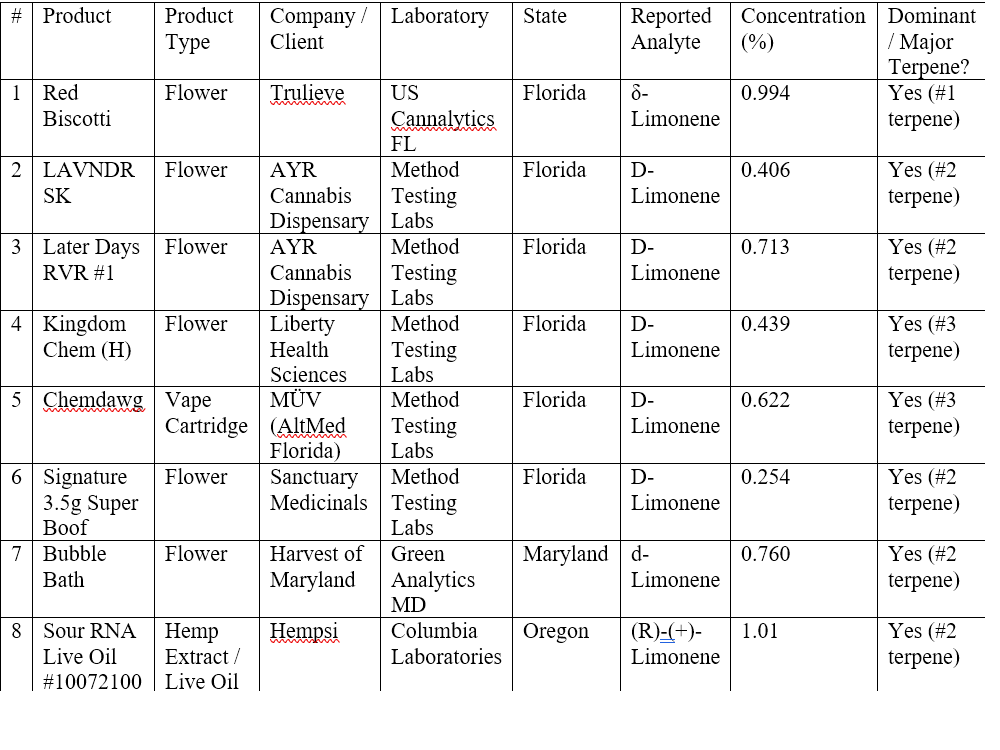
Distinct Reported Nomenclature
US Cannalytics FL: δ-Limonene
Method Testing Labs: D-Limonene
Green Analytics MD: d-Limonene
Columbia Laboratories: (R)-(+)-Limonene
These COAs are inconsistent with the white paper’s categorical framing. A regulated cannabis testing lab reports δ/D-limonene as the dominant terpene in a commercial cannabis flower sample, while also distinguishing other terpene isomers such as α-/β-pinene, cis/trans-nerolidol, p-cymene, and γ-terpinene. Even if one wanted to challenge whether the method is chiral, the white paper’s claim that D/R-limonene is not a major constituent of cannabis is too absolute and does not account for contrary laboratory reporting.
If the conclusion in this regard is to overturn what appears to be the nomenclature used by multiple commercial cannabis labs and assert that cannabis produces predominantly L/(S)-limonene, then we should expect to see the following:
- Chiral column used
- Chromatograms
- Standards
- Retention times
- Number of cultivars analyzed (3)
- Validation data
While these COA do not prove that the testing laboratories performed chiral separation and confirmed (R)-limonene, it does prove that multiple independent cannabis testing organizations across different companies, products, and jurisdictions are reporting d-limonene rather than merely “limonene.” For a white paper to state that d-limonene is not a major constituent of cannabis while 8 products from 4 laboratory ecosystems report d-limonene as a cannabis analyte is a position that demands explanation. At a minimum, the authors would need to explain why these laboratories are all reporting an analyte they claim is mostly absent from the species.
The real problem here is that the paper never appears to seriously engage with substantial contrary evidence. Publishing “Cannabis is ~96% s-limonene and Citrus is ~99% r-limonene” should be followed immediately by serious discussion about why:
- Multiple commercial cannabis COAs report d-limonene
- At least one reports (R)-(+)-limonene
- The broader cannabis testing ecosystem doesn’t appear to be talking about S-limonene dominance
2. Linalool: Useful Signal, Unsupported Product Conclusion
The white paper reports that the three Nexus hemp samples contained 96.8–97.9% S-(+)-linalool, while lavender oil and the two mimic products were R-(−)-linalool dominant. This is another useful analytical observation. Linalool enantiomers can differ in sensory and physiological effects, and the Höferl study cited by the paper is a reasonable reference for the proposition that chirality can matter.
However, the paper again moves too far. It does not show that every cannabis cultivar, every processing method, or every cannabis-derived terpene fraction preserves a 96–98% S-linalool profile. It also does not show that no botanical, purified, enriched, or enantioselective source could deliver the desired enantiomeric ratio. It shows only that the products and oils tested did not match the three Nexus samples.
The phrase “none of these three commodity sources delivers cannabis-matching material” is more careful than many other statements in the paper, but the reader is then invited to generalize the point to all botanical formulation. That is not demonstrated; a formulator’s failure to use the correct stereochemistry is not proof that botanical sourcing can never achieve it.
3. β-Pinene: Ratio Difference Is Not the Same as Superiority
β-Pinene is the paper’s most nuanced monoterpene example. The white paper acknowledges that both cannabis and pine produce mostly the same major β-pinene enantiomer, but that their ratios differ. In the appendix, pine is reported as 98% S / 2% R, the two mimics as 97% S / 3% R and 96.5% S / 3.5% R, and the three Nexus hemp samples as 73% S / 27% R, 71.6% S / 28.4% R, and 84.4% S / 15.6% R.
That is interesting, but the conclusion must be bounded. The data suggest that these two mimic products resemble the tested pine oil more than the tested Nexus hemp samples with respect to β-pinene enantiomeric ratio. They do not show that every cannabis product contains 15–28% R-β-pinene, or that all pine-derived β-pinene is inherently unsuitable for every cannabis formulation target. They also do not establish product-level biological behavior.
The paper cites Rivas da Silva et al. for enantiomer-specific antimicrobial activity of α- and β-pinene. That can support the general principle that pinene enantiomers may differ biologically. It cannot prove that the tested cannabis products, mimic products, or consumer formulations will behave differently in humans under real inhalation or ingestion conditions. That would require product-specific biological testing that is wholly absent from the white paper.
4. PCA: A Visualization, not a Verdict
The paper presents Principal Component Analysis across the 11-compound stereochemical dataset and concludes that “cannabis stands alone.” PCA can be useful for visualizing multivariate separation, but it is not magic. It depends on sample selection, variables chosen, scaling, missing-value handling, and the structure of the dataset. Here the dataset is tiny: three hemp samples, two mimic products, and four botanical oils.
The PCA may show that the three Nexus hemp samples cluster apart from the particular oils and products tested. That is all it can show. It cannot establish that cannabis as a species occupies an exclusive region of chemical space. It cannot establish that no botanical formulation can be built into the same region. It cannot establish sensory superiority or biological superiority. It also cannot rescue broad conclusions from a narrow sample set.
The paper would be stronger if it supplied loadings, variance explained, replicate points, missing-value treatment, confidence ellipses, and independent validation samples. Without those, “cannabis stands alone” is a visually dramatic phrase, not a rigorous conclusion. The graph may be useful; the slogan is not.
5. Molecular Identity vs. Mixture Fidelity
The white paper’s central rhetorical maneuver is to take a valid critique of mixtures and make it sound like a critique of molecular identity. It begins with the claim that marketers say limonene from oranges and limonene from cannabis are chemically identical and interchangeable. It then responds that chiral analysis changes the picture. That is true only if the original claim ignored stereochemistry.
A pure molecule of S-(−)-limonene is the same molecule whether obtained from cannabis, conifers, caraway, dill, bergamot, or an enantioselective synthetic route. A pure molecule of R-(+)-limonene is likewise the same molecule regardless of source. Source can help predict what enantiomer is likely present in a commercial ingredient, but source does not transform the molecule into a different chemical species. If the structure, stereochemistry, and purity are identical, the molecule is identical.
Mixtures are different. A cannabis essential oil, a cannabis-derived volatile fraction, a botanical reconstruction, and a finished vape formulation may all differ in composition, stereochemistry, stability, impurities, matrix, and sensory behavior – that is where the scientific discussion belongs. The claim that “cannabis-derived terpenes are different from botanical terpenes” is sloppy unless it is carefully limited to actual mixtures and actual measured profiles. A molecule is not the same as a chemical profile.
6. The Myth of Complete Cannabis Profile Reconstruction
This is the central argument the paper avoids. No one is routinely recreating complete cannabis profiles in commercial products. Not botanical formulators. Not CDT vendors. Not vape manufacturers. Not concentrate companies. No one.
Cannabis flower contains cannabinoids, cannabinoid acids, neutral cannabinoids, terpenes, terpenoids, esters, aldehydes, ketones, alcohols, volatile sulfur compounds, flavonoids, pigments, sterols, lipids, waxes, oxidation products, degradation products, and numerous trace constituents that remain poorly characterized. Many of these compounds are unstable, matrix-dependent, difficult to quantify, or present below routine detection thresholds. Some are lost during drying, curing, extraction, storage, distillation, decarboxylation, formulation, or heating.
The white paper criticizes botanical mimics for missing whole-plant chemistry. That criticism is valid. But it applies equally to cannabis-derived terpene fractions when those fractions are marketed as though they represent the whole plant. A volatile fraction stripped away from cannabinoids, cannabinoid acids, lipids, waxes, flavonoids, sulfur compounds, esters, and other trace constituents is not a complete cannabis profile simply because the volatile fraction originated in cannabis.
This contradiction should be stated plainly: the paper criticizes botanical formulations for being incomplete representations of cannabis chemistry while defending cannabis-derived terpene fractions that are also incomplete representations of cannabis chemistry. If incompleteness invalidates botanical formulations, then the same standard must be applied to CDT fractions. A fraction remains a fraction, even when the label is wearing a cannabis costume.
The correct standard is not origin alone. The correct standard is measured fidelity: what is present, what is absent, what degraded, what changed, how it compares to the flower or resin target, and whether the final consumer product preserves the claimed chemistry.
7. Sulfur Compounds, Esters, and the Failure of Terpene-Centric Authenticity
The paper itself admits that volatile thiols and esters can contribute disproportionately to cultivar identity at parts-per-million. That admission is important because it undermines terpene-centric authenticity claims. If low-abundance sulfur compounds and esters help define cannabis aroma, then a product cannot claim full cannabis fidelity merely by preserving a few chiral monoterpene ratios.
Oswald and colleagues identified prenylated volatile sulfur compounds that contribute strongly to characteristic cannabis aromas, and later work reported that minor, nonterpenoid volatile compounds can drive important aroma differences among exotic cannabis varieties. These studies support a broader point: cannabis aroma is not reducible to a short terpene list.
Therefore, a CDT product can be stereochemically closer to cannabis than a crude botanical mimic while still failing to reproduce cannabis aroma. It may lack key sulfur compounds. It may lack esters. It may contain altered oxidation products. It may be missing matrix effects. Chiral monoterpene matching is valuable, but it is not complete chemical reconstruction.
8. The Lock-and-Key Problem: Biology Is Not That Simple
The Terpene Belt Farms website states, in connection with the white paper, that “Human biology operates through precise molecular recognition. Receptors bind to specific three-dimensional shapes.” This is partly true, but too simplistic for the role it plays in their argument.
Many receptors and enzymes are stereoselective, and chirality can absolutely matter. But biological recognition is not always a rigid lock-and-key event. Receptors are dynamic proteins. Ligands may bind multiple targets. Effects may arise through allosteric modulation, metabolism, membrane interactions, pharmacokinetics, downstream signaling, or interactions among multiple constituents. The existence of a stereochemical difference does not automatically establish a meaningful biological difference in a finished product.
Olfaction is a particularly important counterexample to simplistic certainty. The classical lock-and-key or shape-based model remains important, but olfactory science has also considered modified shape models, receptor flexibility, combinatorial receptor coding, metabolism of odorants, and controversial vibration-assisted theories. The vibrational theory is debated and has been criticized, but the existence of competing and modified models demonstrates that odor perception should not be reduced to a cartoon of rigid molecular shape.
The white paper’s logic often runs as follows: enantiomers have different three-dimensional forms; receptors recognize three-dimensional forms; therefore the different enantiomer necessarily produces a different sensory or biological outcome. That is not enough. The conclusion must be demonstrated experimentally. Chiral GC can justify a hypothesis about sensory and biological differences. It cannot substitute for sensory panels, GC-olfactometry, receptor assays, pharmacology, or human outcome data.
9. The Thalidomide Example Is Too Simplified
The white paper uses thalidomide as a real-world example of enantiomeric differences, saying the R-enantiomer was a safe sedative while the S-enantiomer caused birth defects. This is the classic classroom story, but as written it is too simple. Thalidomide enantiomers can interconvert under biological conditions, so separating one enantiomer from the other would not eliminate risk. ACS summarizes the point plainly: under biological conditions, thalidomide isomers interconvert, making pre-use separation ineffective.
The reason this matters is not to deny chirality. The reason is to show that biological interpretation of chirality is often more complex than the paper’s examples suggest. Enantiomers can differ; enantiomers can interconvert; metabolites can matter; dose and route can matter; matrix can matter. The paper uses pharmaceutical examples to create rhetorical certainty, but the actual pharmacology is more demanding than the analogy.
10 . Enzymology Is Real, but Not a Commercial Trump Card
The paper is correct that plant terpene synthases can be stereoselective. Cannabis terpene synthases have been characterized, and Booth et al. identified cannabis TPS enzymes where products included β-myrcene, (E)-β-ocimene, (−)-limonene, (+)-α-pinene, β-caryophyllene, and α-humulene. Terpene synthase biology is central to cannabis chemical diversity.
But the paper again overreaches when it moves from enzymatic origin to commercial inevitability. Enzymatic biosynthesis can explain why a plant produces a particular enantiomeric pattern. It does not prove that a non-cannabis source, purification strategy, enriched fraction, or enantioselective synthetic route cannot match a desired chiral target. It also does not prove that a cannabis-derived fraction is complete or stable after extraction, storage, formulation, and heating.
The paper also states that reactions in chemical reactors are generally not stereoselective and produce racemic mixtures. That may describe some commodity synthetic routes, but it is not a universal truth of chemical synthesis. Enantioselective synthesis, chiral catalysts, enzymatic synthesis, chiral resolution, and enriched natural sources all exist. The question is not whether matching stereochemistry is impossible; the question is whether it is practical, verified, and economically plausible for a given product.
11 . Processing, Storage, and the Myth of Static Fidelity
A correct chiral profile at harvest does not guarantee a correct product profile months later. Terpenes are reactive and prone to oxidation, isomerization, rearrangement, evaporation, and degradation. Raeber et al. subjected cannabis terpenes, flowers, and extracts to stress conditions and reported compound-specific degradation patterns, including oxidation and cyclization products, with p-cymene identified as a major terpene aging product.
This matters because “cannabis-derived” is not a stability study. A fraction can be native at collection and altered after storage. A profile can be accurate at extraction and inaccurate at formulation. A product can begin with a cannabis-derived volatile fraction and end as a degraded, incomplete, or selectively enriched aromatic system. The paper does not follow the chemistry from flower to harvested biomass to extracted fraction to stored ingredient to finished product to vapor or aerosol.
Therefore, the origin claim does not solve the fidelity problem. If a company claims that a CDT product preserves cannabis chemistry, then it needs chain-of-custody chemistry: flower baseline, extraction profile, storage profile, formulation profile, heating profile, and batch reproducibility.
12. Entourage Effect: Hypothesis, Not Permission Slip
The entourage effect is often invoked in cannabis marketing as though it were a universal explanatory device. It is not, and in fact the existence of the entourage effect is widely debated among scientists and researchers. Russo’s work and subsequent reviews discuss plausible phytocannabinoid-terpenoid synergy and potential therapeutic relevance, but the evidence remains context-dependent and incomplete. Invoking the entourage effect does not prove an entourage effect in a tested product.
The white paper’s chiral GC data may inform entourage hypotheses, but it does not demonstrate cannabinoid-terpene synergy, clinical outcomes, receptor-level interaction of mixtures, inhalation effects, dose-response behavior, or consumer-relevant biological differences. A chiral terpene profile is one layer of chemistry. It is not a full pharmacological study.
More importantly, if the entourage effect depends on the full matrix, then cannabis-derived terpene fractions without the full matrix cannot claim full entourage fidelity either. If botanical mimics fail because they lack cannabinoids, cannabinoid acids, flavonoids, sulfur compounds, esters, and other trace constituents, then CDT fractions lacking the same constituents fail by the same standard.
The Conclusion and Prediction of the White Paper
The statement that “the global terpene supply chain produces the wrong enantiomer of each of these compounds, and the price of correcting the stereochemistry exceeds what botanical-blending business models can absorb” is not supported by the evidence presented in the white paper.
First, the authors have not demonstrated that the global terpene supply chain produces the “wrong” enantiomer. At most, the paper presents data from three proprietary hemp cultivars showing a particular enantiomeric distribution for limonene, linalool, and β-pinene. From this limited dataset, the authors extrapolate to all cannabis and then further extrapolate to the entirety of the global terpene industry. Neither conclusion is supported by the evidence provided. Before declaring an enantiomer “wrong,” the authors would first need to establish that the stereochemical profile observed in three hemp cultivars is representative of cannabis as a species. The paper does not do this.
Second, the concept of a “wrong” enantiomer is itself scientifically questionable. Enantiomers are distinct molecules with distinct physical, sensory, and biological properties. Whether a particular enantiomer is desirable depends entirely on the intended application. The flavor, fragrance, pharmaceutical, and agricultural industries routinely utilize specific enantiomers based on performance characteristics, availability, regulatory considerations, and cost. An enantiomer cannot be categorically described as “wrong” without defining the biological, sensory, or commercial endpoint being evaluated. The paper provides no evidence that the stereochemical profiles observed in the authors’ hemp cultivars are universally preferable, more effective, safer, or more desirable than alternative enantiomeric compositions.
Third, the assertion that correcting stereochemistry is economically infeasible for botanical terpene companies is unsupported speculation. No economic analysis, manufacturing cost model, market survey, supply-chain assessment, or technoeconomic evaluation is presented. The authors provide no evidence regarding the cost of chiral separation, asymmetric synthesis, fermentation-derived production, selective biocatalysis, stereospecific extraction, or other established industrial methods capable of producing or enriching specific enantiomers. Consequently, the statement is not a scientific conclusion derived from data, but rather an unsupported prediction regarding the economics of an industry.
Finally, the statement ignores the possibility that, if a particular stereochemical profile were demonstrated to possess meaningful commercial value, the marketplace would adapt accordingly. Modern chemical manufacturing already produces countless enantiomerically enriched compounds for pharmaceutical, flavor, fragrance, and specialty chemical applications. The suggestion that the global terpene industry is structurally incapable of responding to demonstrated market demand is contradicted by decades of industrial chemistry and process engineering.
The white paper authors have not demonstrated that the global terpene supply chain produces the “wrong” enantiomers, have not demonstrated that their observed stereochemical profiles are representative of cannabis broadly, and have not provided any economic evidence supporting the claim that alternative production methods are commercially unviable. The statement therefore represents a commercial prediction rather than a scientific conclusion.
What the White Paper Should Have Said
A scientifically careful version of the paper would have been valuable. It would have said something like this:
“In three Nexus 2024 hemp cultivars, we observed S-dominant limonene, S-dominant linalool, and β-pinene ratios that differed from the botanical oils and two commercial mimic products we chose for testing. These results support chiral GC as an authentication and formulation tool and suggest that some commercial mimic products rely on commodity botanical sources that do not match the chiral profiles of these cannabis samples.”
That statement would survive scrutiny. It would make formulators uncomfortable for good reasons. It would push the industry toward chiral analysis. It would also avoid pretending that three cultivars and two unnamed products settle the entire CDT-versus-BDT debate.
Instead, the paper repeatedly moves from “these products differ from these samples” to “cannabis stands alone,” “botanical mimics do not behave the same,” and “the global terpene supply chain produces the wrong enantiomer.” That is not careful scientific writing. It is commercial overreach.
The paper would also have benefited from a more thorough engagement with the existing literature on chiral terpene analysis in cannabis. One of the most relevant studies to the paper’s central analytical approach, Raeber et al. (2025), is included in the reference list under the incorrect title “Chiral Gas Chromatography of Cannabis Terpenes,” although DOI 10.1002/pca.3432 corresponds to the publication “Comprehensive Analysis of Chemical and Enantiomeric Stability of Terpenes in Cannabis sativa L. Flowers.”
More importantly, the study is never discussed in the body of the paper despite addressing the very subject matter upon which many of the paper’s conclusions depend. As a result, readers are asked to accept broad claims regarding stereochemistry, authenticity, and terpene sourcing without any meaningful discussion of how those claims align with, differ from, or build upon one of the most relevant cannabis-specific investigations of terpene enantiomeric composition and stability.
A more rigorous treatment would have accurately identified the study and directly addressed its findings within the context of the authors’ conclusions.
A Defensible Standard for Cannabis Profile Claims
If a company claims its product more faithfully represents cannabis than a botanical formulation, the evidence should include at least the following:
- Chiral GC analysis for relevant chiral monoterpenes and terpenoids, with replicate data and uncertainty.
- Full GC-MS and, where appropriate, GC×GC-MS profiling across terpenes, terpenoids, esters, aldehydes, ketones, alcohols, and other volatiles.
- Targeted sulfur analysis for prenylated VSCs and other low-threshold sulfur compounds.
- Quantification of cannabinoids and cannabinoid acids when whole-profile, entourage, or cannabis-matrix claims are made.
- Stability data across harvest, extraction, storage, formulation, and heating.
- Batch-to-batch and harvest-to-harvest reproducibility.
- Sensory validation through trained panels and, where appropriate, GC-olfactometry.
- Biological testing if functional, receptor, or pharmacological claims are made.
- Clear disclosure of what is absent, not merely what is present.
Final Observation: Science Communication vs. Marketing Communication
Figure 1 shows a Terpene Belt Farms advertisement on Google claiming the company is the “leading manufacturer of terpenes in the USA.” Whether that claim is true or false is not the point. No supporting production data, market-share analysis, revenue rankings, customer metrics, or third-party assessments are provided, referenced, or linked to on the associated website, leaving the reader unable to independently evaluate the statement.
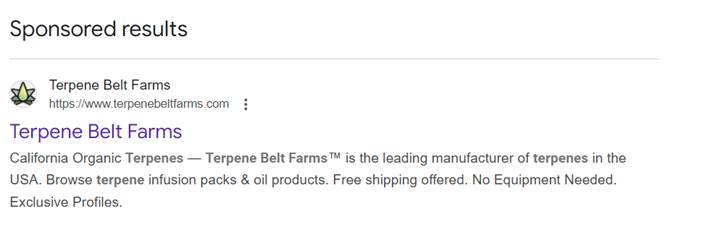
Figure 1 – Pay-per-click Campaign of Terpene Belt Farms (June 9, 2026)
The same pattern appears throughout the white paper. Measurable stereochemical differences are presented, terms such as “correct,” “wrong,” “authentic,” and “cannabis-matching” are introduced, and broader conclusions are implied without corresponding biological, sensory, pharmacological, or commercial evidence.
The paper’s chemistry is often legitimate. The issue is not the existence of analytical differences; the issue is the repeated tendency to transform those differences into conclusions that extend beyond what the data directly demonstrates. The advertisement and the white paper therefore share a common feature: both rely upon language that encourages readers to accept conclusions that are stronger than the supporting evidence presented.
The chemistry deserves consideration. The conclusions deserve scrutiny.
Finally, 48 hours after downloading the white paper, the author received the following message from a representative of Nexus Agriscience (emphasis added):
“Thanks for downloading our white paper on the difference between cannabis and botanical terpenes!
We have built all of the skus in our Terpene Belt Farms & Duty Free Terpenes brands around authentic cannabis terps – because you can’t replicate the real thing.
Now that you’ve read the white paper do you want to experience the difference by trying some of our samples?”
48 hours after this message was sent, the author received an additional follow-up sales pitch from the same representative.
This indicates that the white paper in question likely sits at the top of a sales funnel for Nexus Agriscience, lending additional credibility to the idea that the paper is more marketing communication than scientific communication for the industry.
Conclusion
The white paper deserves credit for bringing stereochemistry into a cannabis conversation that too often treats terpene names as sufficient. They are not sufficient. Enantiomeric composition matters and chiral GC matters. Standard terpene COAs often miss important information. On that foundation, the paper is correct.
But the paper builds too much on too little. It uses three hemp cultivars, two unnamed mimic products, and four botanical oils to support broad claims about cannabis, botanicals, sensory performance, biological behavior, the entourage effect, and the global terpene supply chain. That is not the strength of the paper – it is the weakness.
The deepest flaw is not the limonene section, the linalool section, or the PCA plot. The deepest flaw is the implied equivalence between cannabis-derived terpene fractions and complete cannabis chemistry. A CDT fraction may be more native than a crude botanical blend. It may preserve certain chiral ratios better. It may smell closer to some cannabis targets. But it is still a fraction. It is not a complete cannabis profile.
A serious cannabis chemistry standard would not ask whether a product can say “cannabis-derived” on the label. It would ask what is present, what is missing, what degraded, what changed, what was measured, what was not measured, and whether the claimed sensory or biological effect was demonstrated. That is the conversation the industry should be having.
Until then, the claim that cannabis-derived terpenes and botanical terpenes are categorically “not the same” remains imprecise at best and misleading at worst. Mixtures can differ, enantiomeric ratios can differ, trace constituents can differ, and biological and sensory effects may differ. But molecules do not acquire authenticity by origin story. Chemistry is not impressed by marketing copy. And R-linalool is the same exact molecule whether it’s found in cannabis or any other plant.
References
Nexus Agriscience / Terpene Belt Farms. Are Cannabis-Derived Terpenes Actually Different from Botanical Terpenes? Isomerism and Stereochemistry in Cannabis Essential Oil. White Paper Series, Paper 1. 2026.
Raeber, J.; Bajor, B.; Poetzsch, M.; Steuer, C. Comprehensive analysis of chemical and enantiomeric stability of terpenes in Cannabis sativa L. flowers. Phytochemical Analysis. 2025;36(1):205–217. doi:10.1002/pca.3432.
Booth, J. K.; Page, J. E.; Bohlmann, J. Terpene synthases from Cannabis sativa. PLOS ONE. 2017;12(3):e0173911. doi:10.1371/journal.pone.0173911.
Booth, J. K.; Yuen, M. M. S.; Jancsik, S.; Madilao, L. L.; Page, J. E.; Bohlmann, J. Terpene Synthases and Terpene Variation in Cannabis sativa. Plant Physiology. 2020;184(1):130–147.
Oswald, I. W. H. et al. Identification of a New Family of Prenylated Volatile Sulfur Compounds in Cannabis Revealed by Comprehensive Two-Dimensional Gas Chromatography. ACS Omega. 2021;6(47):31667–31676. doi:10.1021/acsomega.1c04196.
Oswald, I. W. H. et al. Minor, Nonterpenoid Volatile Compounds Drive the Aroma Differences of Exotic Cannabis. ACS Omega. 2023;8(42):39203–39216. doi:10.1021/acsomega.3c04496.
Höferl, M.; Krist, S.; Buchbauer, G. Chirality influences the effects of linalool on physiological parameters of stress. Planta Medica. 2006;72(13):1188–1192. doi:10.1055/s-2006-947202.
Aprotosoaie, A. C.; Hăncianu, M.; Costache, I.-I.; Miron, A. Linalool: a review on a key odorant molecule with valuable biological properties. Flavour and Fragrance Journal. 2014;29(4):193–219. doi:10.1002/ffj.3197.
Rivas da Silva, A. C. et al. Biological activities of α-pinene and β-pinene enantiomers. Molecules. 2012;17(6):6305–6316. doi:10.3390/molecules17066305.
Gertsch, J. et al. Beta-caryophyllene is a dietary cannabinoid. Proceedings of the National Academy of Sciences USA. 2008;105(26):9099–9104. doi:10.1073/pnas.0803601105.
Russo, E. B. Taming THC: potential cannabis synergy and phytocannabinoid-terpenoid entourage effects. British Journal of Pharmacology. 2011;163(7):1344–1364. doi:10.1111/j.1476-5381.2011.01238.x.
Ferber, S. G. et al. The “Entourage Effect”: Terpenes Coupled with Cannabinoids for the Treatment of Mood Disorders and Anxiety Disorders. Current Neuropharmacology. 2020;18(2):87–96.
Hoehn, R. D.; Nichols, D. E.; Neven, H.; Kais, S. Status of the Vibrational Theory of Olfaction. Frontiers in Physics. 2018;6:25. doi:10.3389/fphy.2018.00025.
Block, E. et al. Implausibility of the vibrational theory of olfaction. Proceedings of the National Academy of Sciences USA. 2015;112(21):E2766–E2774. doi:10.1073/pnas.1503054112.
International Agency for Research on Cancer. d-Limonene. Some Naturally Occurring Substances. IARC Monographs. NCBI Bookshelf.
American Chemical Society. Thalidomide. Molecule of the Week. 2014. Summary notes that thalidomide enantiomers interconvert under biological conditions.
Leave a Reply
You must be logged in to post a comment.